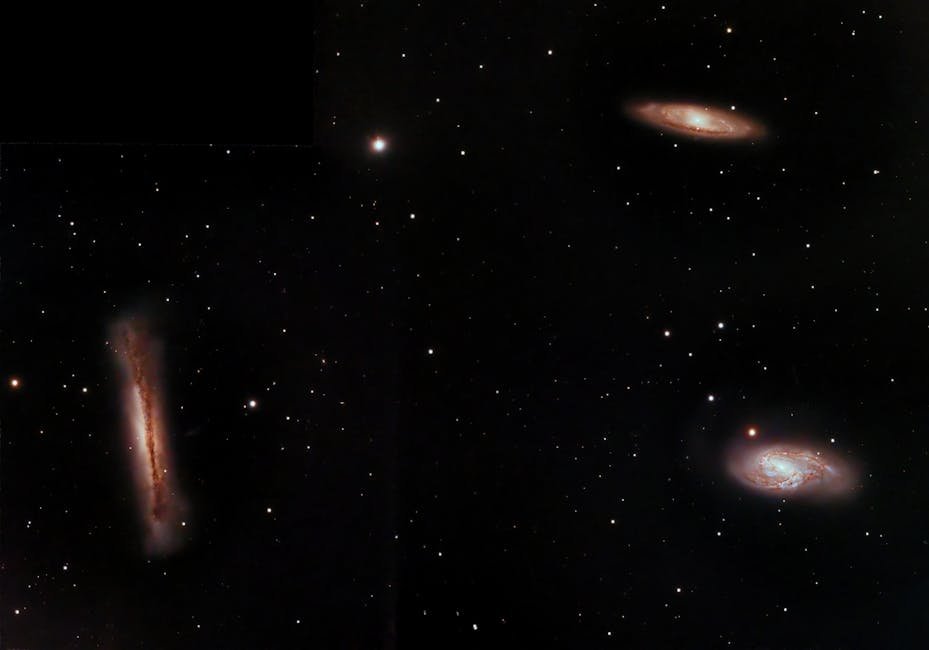
The universe is full of mysteries, but none are more perplexing than the recent discovery made by the James Webb Space Telescope: a black hole that formed before its host galaxy. This revelation challenges the very foundations of our understanding of cosmic evolution and opens a Pandora’s box of questions about the nature of science itself.
According to reports from Google News, the James Webb Space Telescope has identified a black hole that appears to have come into existence long before the galaxy it now inhabits. Scientists are scratching their heads, unsure of how this anomaly could have formed in the early universe.
The Science Behind the Discovery
This discovery matters now more than ever, as it forces us to reevaluate existing scientific theories about black hole formation and the timeline of cosmic evolution. Traditionally, scientists believed that black holes formed as a consequence of stellar collapse within galaxies. This finding disrupts that narrative, suggesting that some black holes could have emerged during a much earlier epoch, perhaps even from primordial gas clouds. The implications are far-reaching, as they could reshape our understanding of galactic formation and the evolutionary history of the universe.
The key players in this cosmic drama are not just astronomers but the very technologies that enable them to probe the depths of space. The James Webb Space Telescope, with its powerful instruments designed to capture distant light and uncover hidden phenomena, stands at the forefront of this scientific revolution. As we seek to understand this black hole’s origins, we must also consider the limitations and challenges of our current scientific methodologies.
Hot Take: What This Means for the Future
Who wins in this scenario? The scientific community, for one, as they gain a tantalizing thread to pull on in their quest for knowledge. However, this discovery also highlights the fragility of our scientific understanding; at any moment, a new finding can overturn decades, even centuries, of established thought. The mainstream narrative, which often presents science as a linear path of progress, is embarrassingly simplistic. Science is not a straight line; it’s a labyrinthine journey filled with dead ends, unexpected detours, and revelations that change everything we thought we knew.
On the other hand, there are significant stakes in how we interpret this black hole’s formation. If scientists cannot provide a satisfactory explanation, we risk undermining public trust in science itself. After all, if the theories governing the universe can be so easily upended, what does that mean for other scientific “certainties”?
Moreover, as exciting as it is to uncover new cosmic truths, we must be cautious about drawing conclusions too quickly. Theories will evolve, but they must do so grounded in rigorous scientific inquiry, not sensationalism. As researchers continue to delve into this mystery, we should remain open to new ideas while also demanding the necessary rigor that underpins the scientific method.
So, what’s next for the James Webb Space Telescope and its quest to unravel the cosmos? Will this black hole rewrite the story of our universe, or will it simply be a stepping stone to even stranger revelations? Only time and continued exploration will tell. In the end, the true challenge for science may not be to explain this anomaly but to remain adaptable in the face of cosmic uncertainty.
Source: Google — Space & Science