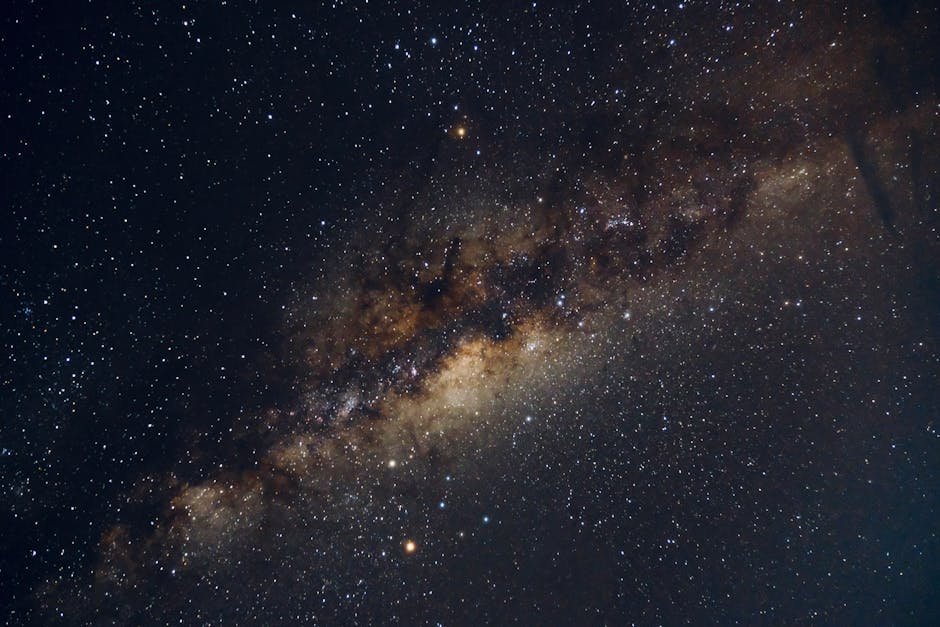
The universe just threw us a curveball, and it’s shaking the very foundations of our understanding of black holes. The James Webb Space Telescope has uncovered a black hole that formed long before its host galaxy — a revelation that forces us to confront unsettling questions about the origins of our universe. What does this breakthrough in science mean for our cosmic narrative, and why are we only beginning to scratch the surface?
According to a report from Space, scientists are baffled by this recent discovery. The black hole, identified by the Webb telescope, predates the galaxy that surrounds it, leaving researchers struggling to understand how such a cosmic anomaly occurred. This unprecedented finding could rewrite the textbooks on astrophysics and our understanding of black hole formation.
The Cosmic Context of This Discovery in Science
To appreciate the gravity of this discovery in science, we need to understand where we stand. Traditionally, black holes are seen as the aftermath of massive stars collapsing after their life cycles. The prevailing theory has always been that galaxies form first, with black holes emerging within or alongside these cosmic titans. However, the James Webb Space Telescope’s revelation disrupts that linear progression. It suggests a reality where black holes can exist independently, even before the structures we associate them with materialize.
This paradigm shift comes at a time when space exploration and astronomical discoveries are gaining unprecedented momentum. The James Webb Space Telescope, with its advanced capabilities, has been peering deeper into the universe than ever before, uncovering secrets that challenge long-held assumptions. The players in this cosmic game are not just scientists and researchers; they include curious minds worldwide hungry for knowledge and the implications this has for our understanding of the universe.
The Stakes of Our Understanding in Science
What does this mean for the future? First, let’s acknowledge the immediate winners: researchers and astrophysicists. This discovery opens new avenues for exploration and understanding, inviting scientists to rethink theories about the formation and evolution of the universe. However, the implications are vast and complicated. A black hole existing before its galaxy raises possibilities of other unforeseen phenomena lurking in the cosmos that we have yet to explore.
On the flip side, there’s a risk of disillusionment. The academic community has long relied on established models, and this disruption could lead to a backlash against new theories. Some may cling to the old ways of thinking, resistant to the idea that everything we thought we knew is possibly up for grabs. What if, instead of moving forward, we spiral into a quagmire of confusion and debate?
The mainstream narrative often simplifies complex scientific issues. The chance that this black hole could reinterpret the timeline of cosmic evolution is a thrilling, yet daunting prospect. As we grapple with this discovery, we must remain critical and curious, allowing our understanding of science to evolve alongside our findings.
In this age of exploration, the cosmos can be as humbling as it is fascinating. The James Webb Space Telescope’s revelation has not only expanded our knowledge but has also ignited a fire under the feet of scientists. We stand at a crossroads where everything we know about black holes could be overturned. So, what will we do with this knowledge? As we look to the stars, let’s remember: the universe has a way of keeping us on our toes. The future of science is at stake, and it’s more unpredictable than ever.
Source: Google — Space & Science