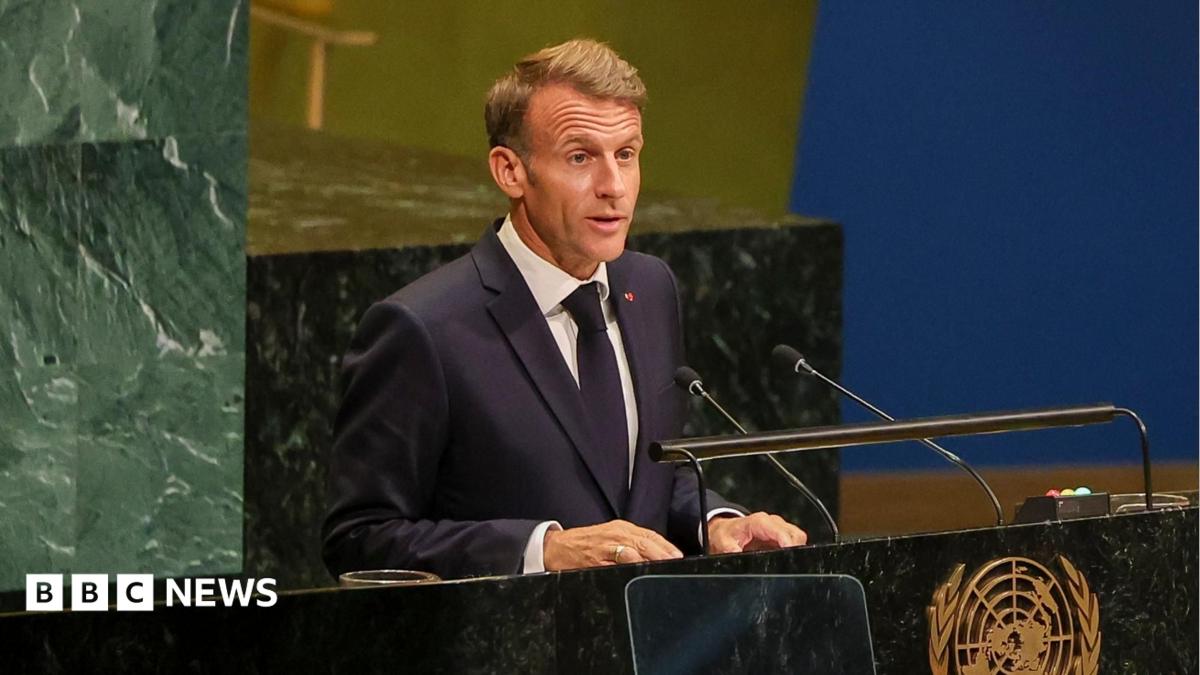
Netanyahu’s fury at Emmanuel Macron’s UN remarks reveals a diplomatic fault line that few Western commentators are willing to name. The Israeli prime minister called the French president’s comments “grotesque,” insisting they betray a naïve view of the West Bank that could embolden Hamas. In a world where political theater often masks hard realities, Netanyahu’s outburst is more than a personal insult; it is a warning shot aimed at a Europe that seems increasingly detached from on‑the‑ground terror.
According to the BBC, Macron, speaking at a United Nations gathering, suggested that the violence in the occupied West Bank was not solely the work of Hamas but also reflected broader grievances among Palestinians. Netanyahu, in turn, blasted the remarks as an attempt to “downplay” Hamas’s murderous campaign, accusing the French leader of romanticising a conflict that is anything but a simple protest. The exchange unfolded as the UN debated a resolution condemning recent attacks that have left dozens dead and injured many more.
Netanyahu and Macron: a diplomatic flare‑up in the Middle East
The clash between Netanyahu and Macron cannot be reduced to a personal spat; it mirrors a growing rift between Israel’s right‑wing government and a European bloc that is gradually reshaping its stance on the occupied territories. Since the October 2023 war, Israel has tightened its grip on the West Bank, expanding settlements and increasing military patrols. Meanwhile, France, under Macron’s leadership, has pushed for renewed dialogue with Palestinian authorities, framing the conflict as a political dispute rather than a purely security nightmare.
Netanyahu’s administration has repeatedly warned that any concession on the West Bank would be a strategic disaster. In his latest speech, he argued that “the only way to guarantee Israeli lives is to confront the terrorist infrastructure wherever it hides.” By branding Macron’s comments grotesque, Netanyahu is signaling that Israel will not tolerate what it perceives as diplomatic soft‑selling of its security concerns. The French president, for his part, appears to be walking a tightrope—balancing domestic pressure from a pro‑Palestinian electorate with the need to maintain strategic ties to a key ally in the region.
The timing of the exchange is crucial. The UN debate follows a series of coordinated attacks by Hamas cells operating from the West Bank, which have targeted Israeli civilians and security forces alike. These incidents have forced Netanyahu to justify a harsher security posture, including the recent deployment of additional troops and the expansion of checkpoint networks. At the same time, Macron’s remarks echo a broader European trend that seeks to label Israel’s settlement policy as “illegal” under international law, a label that Netanyahu has long dismissed as politically motivated.
The broader stakes for the West Bank conflict
What the mainstream media often omits is how this diplomatic showdown could reshape the daily lives of Palestinians living under occupation. If Israel escalates its security operations in response to perceived European soft‑selling, we could see a surge in curfews, house demolitions, and restrictions on movement. Such measures would exacerbate the humanitarian crisis that the United Nations has already warned could spiral into a new wave of displacement.
Conversely, if Macron’s approach gains traction among EU capitals, Israel might find itself increasingly isolated on the diplomatic front. Economic incentives, such as EU trade agreements or research collaborations, could be leveraged to pressure Netanyahu into easing settlement expansion. However, the Israeli prime minister has shown a willingness to sacrifice international goodwill for what he frames as existential security. As a result, the risk of a broader regional escalation looms large, especially if Palestinian factions interpret a hardened Israeli stance as a green light for further attacks.
Critics of Netanyahu argue that his hardline rhetoric only fuels the very narrative that Hamas exploits—portraying Israel as an oppressor unwilling to negotiate. They point out that a purely militaristic response cannot address the root causes of the conflict: land, identity, and a lack of political representation for Palestinians. Yet Netanyahu’s supporters counter that any concession would be a victory for terror groups, emboldening them to launch more sophisticated operations across the occupied territories.
The reality likely sits somewhere in the middle. While Israel’s security concerns are genuine—evidenced by the recent spike in Hamas‑linked attacks—Macron’s call for a more nuanced dialogue is not without merit. A sustainable solution will require both sides to recognize the limits of force and the necessity of political engagement. As it stands, Netanyahu’s denunciation of the French president may deepen the diplomatic divide, making the prospect of a negotiated peace even more remote.
Netanyahu’s sharp rebuke of Macron is a reminder that the West Bank is far from a static front line; it is a volatile arena where politics, security, and human rights intersect in unpredictable ways. The next few weeks will test whether Israel’s hard‑line posture can withstand growing European criticism, or whether the pressure will force a recalibration of policy that could alter the trajectory of the conflict.
In the end, the question is not whether Netanyahu or Macron will win this rhetorical battle, but which narrative will shape the lives of those caught in the crossfire. If the international community continues to ignore the human cost while debating diplomatic semantics, the only predictable outcome is more bloodshed and deeper mistrust. The world would do well to watch closely, because the fallout from this clash may reverberate far beyond the halls of the United Nations.
Source: BBC Middle East