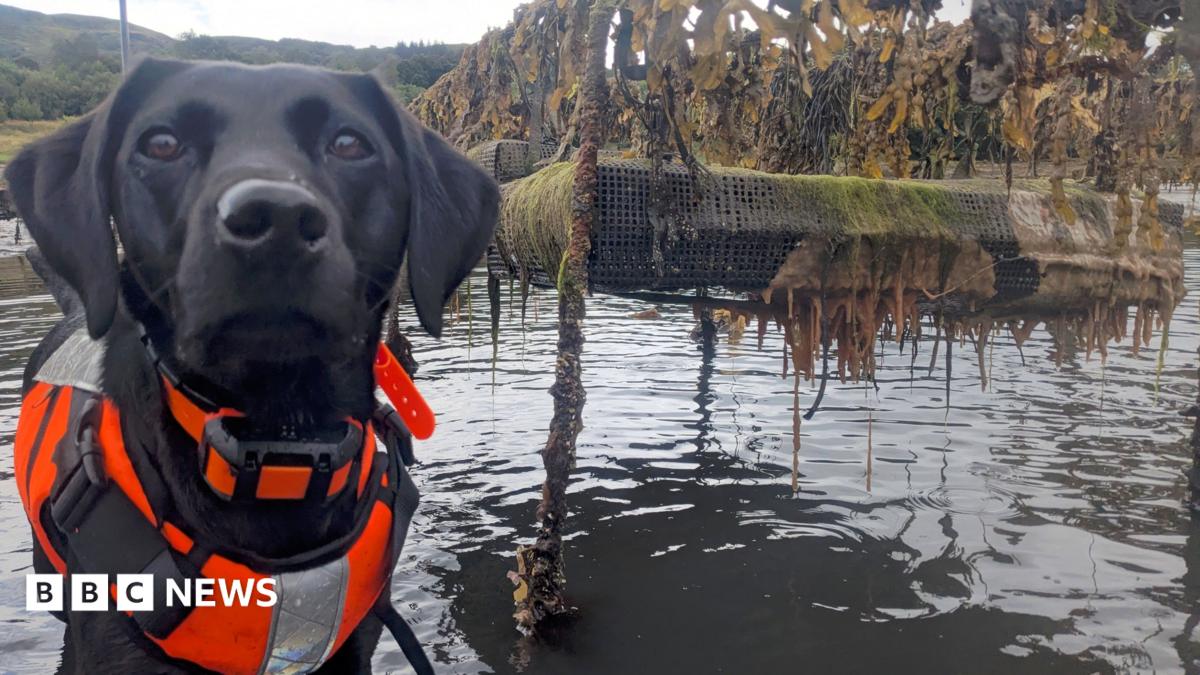
Dog has never been more political than when a Labrador‑border collie mix trotted onto the stage of Britain’s environmental elite and was crowned “Animal of the Year.” The very notion that a canine could be celebrated for hunting an oceanic pest feels like a punch‑line, yet it also exposes a thin‑skinned complacency about how invasive species threaten national security.
According to the BBC, Sgiath – a four‑year‑old dog from Pembrokeshire – is believed to be the United Kingdom’s first sea‑squirt‑hunting animal. Trained by marine biologists, the dog sniffs out the invasive tunicate, colloquially dubbed “sea vomit,” before it can smother native mussels and disrupt coastal ecosystems.

The Dog’s Unexpected Role in Britain’s Biosecurity Strategy
The story of Sgiath is not just a feel‑good animal‑rights anecdote; it is a micro‑case study of how the UK is grappling with a growing, under‑appreciated threat. Sea squirts, native to the Pacific, have been hitchhiking on hulls, fishing gear and even cargo containers for decades. Once they establish a foothold, they multiply at a ferocious rate, outcompeting native shellfish and altering the food chain. In fact, the Department for Environment, Food & Rural Affairs warned last year that the pest could cost the aquaculture sector up to £150 million annually if left unchecked.
Enter the dog. By training Sgiath to locate the organism on rocky shores and in marinas, scientists have added a low‑tech, high‑precision tool to a toolbox that otherwise relies on expensive sonar scans and labor‑intensive diver surveys. The canine’s nose can detect the chemical signature of the tunicate from a few metres away, allowing rapid mapping of infestations. This efficiency matters because early detection is the cornerstone of any biosecurity regime; once an invasive species spreads, eradication becomes exponentially harder and far more costly.

The diplomatic dimension is equally salient. The UK’s post‑Brexit trade deals increasingly hinge on environmental standards, and invasive marine species are a recurring clause in agreements with EU neighbours and Commonwealth partners. If Britain cannot demonstrate effective containment measures, it risks being labeled a “soft target” for ecological leakage, which could sour future fisheries negotiations. Moreover, the Ministry of Defence has quietly flagged marine bio‑invasions as a potential threat to naval infrastructure, noting that fouling on hulls can reduce fuel efficiency and increase maintenance costs—issues that directly affect operational readiness.
Sgiath’s success also underscores a broader shift toward “One Health” thinking, where human, animal and ecosystem health are seen as interdependent. By harnessing a dog’s olfactory prowess, the UK is effectively turning a domestic companion into a frontline sentinel for national security. The move challenges the conventional hierarchy of defense assets, suggesting that future strategies might blend technology with trained animals in ways that were once the realm of science‑fiction.

Hot Take: From Cute Novelty to a Blueprint for Future Defense
The mainstream narrative will likely celebrate Sgiath as an adorable footnote in the fight against invasive species, but that framing misses the deeper implication: the dog is a prototype for a new breed of low‑cost, high‑impact security assets. If a Labrador can sniff out sea‑vomit, why not train dogs to detect smuggled contraband in ports, or even chemical signatures of cyber‑physical threats hidden in cargo? The answer lies in the economics of deterrence. A trained dog costs a fraction of a satellite, yet can operate in real‑time, on the ground, and without the need for a constant data‑link that could be jammed.
Critics will argue that relying on a canine solution is a gimmick, that it distracts from investing in autonomous underwater vehicles or AI‑driven monitoring systems. That objection has merit; no single tool can replace a comprehensive surveillance network. However, the reality is that budget constraints and bureaucratic inertia often stall large‑scale tech roll‑outs, while a dog can be trained and deployed within months. The British government, already strained by post‑pandemic fiscal tightening, would do well to recognize the strategic elasticity that a dog offers.
There is also a cultural argument. Britain’s naval tradition is steeped in icons of steel and steam; introducing a dog into the narrative forces a re‑evaluation of what constitutes a “defender.” The public’s affection for Sgiath could translate into broader support for funding unconventional defense projects, a political windfall that could tip the scales in favour of innovative bio‑security programmes. On the other hand, if the novelty wears off, the dog could become a footnote, and the underlying invasive threat would continue to spread unchecked.
The risk of over‑reliance is real. A single animal cannot cover the entire coastline, and training capacity is limited. Yet, if the dog model is scaled—through partnerships with local kennel clubs, university research units, and community volunteers—it could evolve into a distributed network of scent‑based monitors, much like citizen‑science bird‑counting schemes. Such a network would provide granular, real‑time data that could be fed into AI algorithms, creating a feedback loop where biology informs technology and vice‑versa.
In short, Sgiath is more than a mascot; the dog is a proof‑of‑concept that blurs the line between environmental stewardship and national security. The question now is whether policymakers will treat the story as a heart‑warming side note or as a catalyst for re‑thinking Britain’s defense architecture.
If the UK continues to treat invasive marine pests as an ecological inconvenience, the cost will be measured in lost jobs, degraded coastlines and a tarnished diplomatic reputation. If, instead, it embraces the dog as a symbol of adaptive security, we may witness a new chapter where four‑legged allies patrol our shores alongside drones and satellites. The choice, as always, lies not with the dog, but with the officials who decide how far they are willing to let a Labrador sniff out the future.
Source: BBC UK