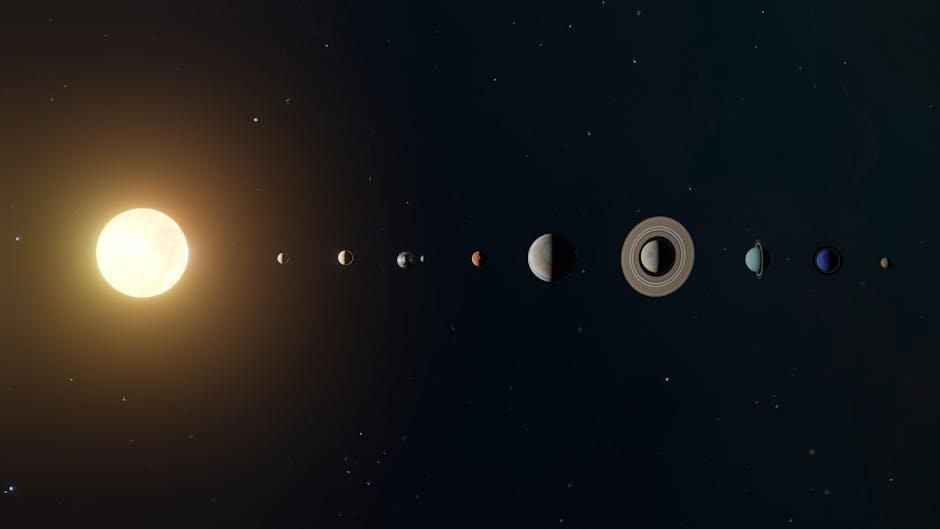
What does it mean when science reveals a planet that not only scorches the very definition of habitability but also outgrows our own Earth? The revelation of a Mercury-like planet larger than our own is causing more than just a stir in the scientific community; it’s a wake-up call to humanity’s place in the universe.
According to ScienceAlert, the James Webb Space Telescope (JWST) has unveiled an exoplanet that mirrors Mercury’s harsh conditions but supersedes it in size, igniting intrigue among astronomers and enthusiasts alike. This celestial body, bombarded by its nearby star, stretches beyond Earth’s dimensions, challenging our understanding of planetary formation and habitability.
The Importance of This Discovery in Science
Why should we care about a scorched planet millions of miles away? The answer lies in our innate desire to understand the cosmos, our origins, and potentially, our fate. This discovery is more than mere data; it’s a key to unraveling the mysteries of planetary evolution. The JWST’s findings come on the heels of a growing interest in exoplanets and the conditions that foster life. While Earth remains our sole refuge, every new planet discovered opens a Pandora’s box of possibilities and ponderings.
This exoplanet’s existence questions the limits of what we define as ‘Earth-like.’ It forces us to reconsider what makes a planet potentially habitable. The scientific community has long been confined to a narrow set of criteria when discussing the conditions that support life. However, the presence of a larger-than-Earth body in hostile conditions may redefine that scope. It’s a reminder that while we look for life in the same image of ourselves, the universe may have other plans.
The Stakes of Understanding Exoplanets in Science
So, who stands to gain from this celestial revelation? For scientists, it’s an opportunity to recalibrate our planetary models. For the layman, it’s a chance to dream bigger. But it’s not all rosy; the hype surrounding such discoveries can lead to the oversimplification of complex celestial dynamics. The mainstream narrative often ends at “look at this cool planet,” disregarding the nuanced discussions on how we draw the line between habitability and inhospitable conditions.
The real danger lies in our penchant for anthropocentrism. As we gaze into the void and discover new planets, we must avoid the trap of asserting that life must take a familiar form. The idea of a Mercury-like planet larger than Earth could be mistakenly hailed as a potential location for future human life. However, the truth is that not every planet capable of harboring life in our wildest dreams is suited for human existence.
What happens when we reach for the stars without preparing adequately? The failure to recognize the differences between Earth and its extraterrestrial counterparts could lead to misguided missions or extravagant resource allocations. The temptation to colonize planets that don’t fit our definition of ‘comfortable’ could result in catastrophic miscalculations.
In conclusion, the discovery of this scorched, Mercury-like planet is a glorious testament to the power of science and human curiosity. Yet, as we chart new territories in our quest for cosmic understanding, we must tread carefully. The universe is a vast and complex tapestry of possibilities, and not every thread will lead us closer to home. Will we embrace the lessons this planet has to offer, or will we continue to tread the dangerous waters of assumption? The universe, as it turns out, doesn’t owe us a thing.
Source: Google — Space & Science