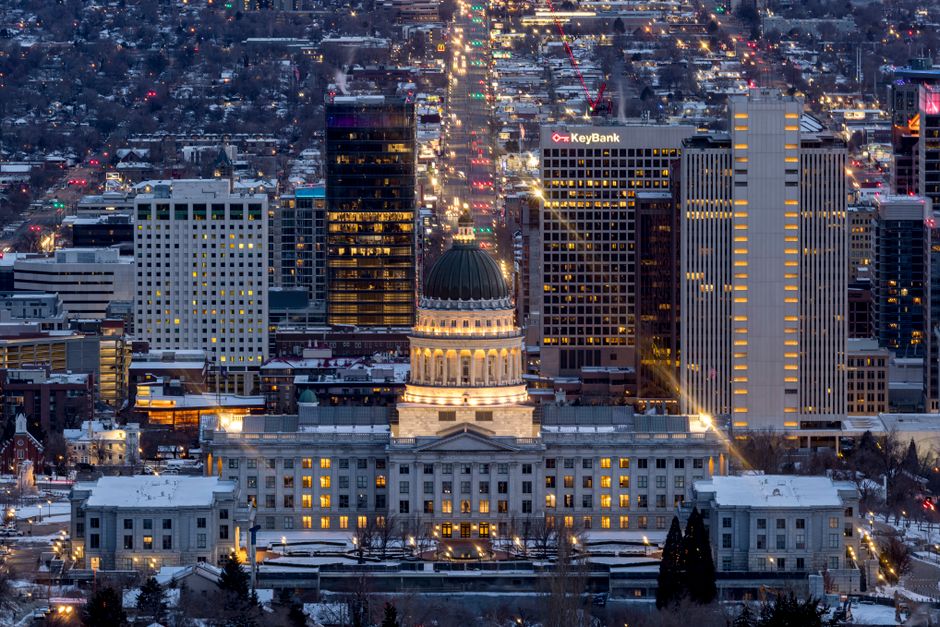
In the bustling municipal landscape of **Salt Lake**, clarity is paramount, yet sometimes, even the most straightforward announcements manage to tangle themselves in a knot of conflicting signals, leaving more questions than answers.
This week, Waqya.com received what purported to be an official dispatch detailing significant developments within Salt Lake City. Ostensibly, the news concerned the Gilgal Sculpture Garden, a local institution long celebrated for its unique, abstract artistry and often-overlooked charm. The dispatch suggested a highly anticipated positive step forward: the garden, after decades of passionate advocacy and sustained community effort, was finally moving towards official designation as a local landmark site. Such a move would not only secure its future against the ever-present pressures of urban development but also formally acknowledge its profound cultural and historical importance to the city. It promised a commendable outcome for a truly unique piece of civic heritage, a victory for local arts and preservationists.
What landed
On the surface, the core message regarding the Gilgal Sculpture Garden is undoubtedly a win for the city and its residents. For years, the garden, with its distinctive and often enigmatic sculptures and structures, has captivated visitors, offering a meditative, almost spiritual space amidst the urban sprawl. The journey towards official recognition, as hinted at in the dispatch, has been a long and often arduous one, requiring persistent lobbying and public engagement. The prospect of landmark status offers a tangible safeguard, ensuring its preservation for future generations, protecting it from the wrecking ball and ensuring its continued accessibility. It’s a moment where local government appears to be listening to and acting upon deeply rooted community sentiment, a rare and welcome instance of bureaucratic wheels turning in the right direction for cultural enrichment. The summary suggests a battle fought on behalf of art and history, and perhaps, finally, won through concerted effort. This recognition would not just be about bricks and mortar or sculpted stone, but about affirming a vital piece of Salt Lake’s unique identity.
What doesn’t add up
However, any attempt to verify or expand upon this seemingly positive development quickly descends into a labyrinth of confounding inconsistency, casting a skeptical shadow over the entire message. The very document meant to convey this news, rather than offering a clear factual account, appears to suffer from a profound identity crisis. While the primary headline and summary unequivocally point to the Gilgal Sculpture Garden’s landmark designation, a piece of news that would resonate deeply with local preservation groups and art enthusiasts, the accompanying digital breadcrumb – the URL provided as the source – tells an entirely different, and equally significant, story. That link, presented as the definitive source of information, refers instead to ‘The Final 50 Acres: University of Utah and Army Holds Ceremony Finalizing Transfer of Fort Douglas.’
This isn’t a minor typographical error, a simple typo that could be easily dismissed as an oversight. It’s a fundamental, jarring disconnect between the stated subject and its supposed factual underpinning. Are we, the public, to believe that Salt Lake City is simultaneously making strides in cultural preservation by designating a quirky sculpture garden *and* finalizing a major, multi-institutional land transfer involving the University of Utah and the US Army? These are two vastly different types of civic action, involving different city departments, different stakeholders, and different public interests, each with its own significant implications for the city’s future. Or, more likely, is there a significant and frankly baffling mix-up in the official channels meant to inform the public? This kind of internal contradiction in what should be a straightforward public announcement not only sows deep confusion but actively undermines the credibility of the information itself. When the delivery mechanism for public information is so muddled, one has to question not just the details, but the entire narrative. It forces a skeptical eye on the veracity of *any* official communication, leaving citizens to wonder what *really* happened, and which ‘landmark’ decision – the cultural or the institutional – is the actual focus. The wry implication is that if basic facts cannot be correctly aligned, how can more complex policy decisions be trusted?
Come Monday morning, Salt Lake City residents might be left wondering not just about the future of Gilgal, or the implications of the Fort Douglas land transfer, but about the fundamental reliability of the very channels meant to keep them informed. When official messaging contradicts itself so openly, whether through oversight or systemic disarray, public trust erodes, and the real impact of any vital civic decision gets lost in the noise of administrative oversight. For a community that values its unique heritage and expects transparent governance, such disarray is more than just inconvenient; it’s a disservice, hinting at a deeper need for clarity in the city’s public communications.
Source: OnTheRecord