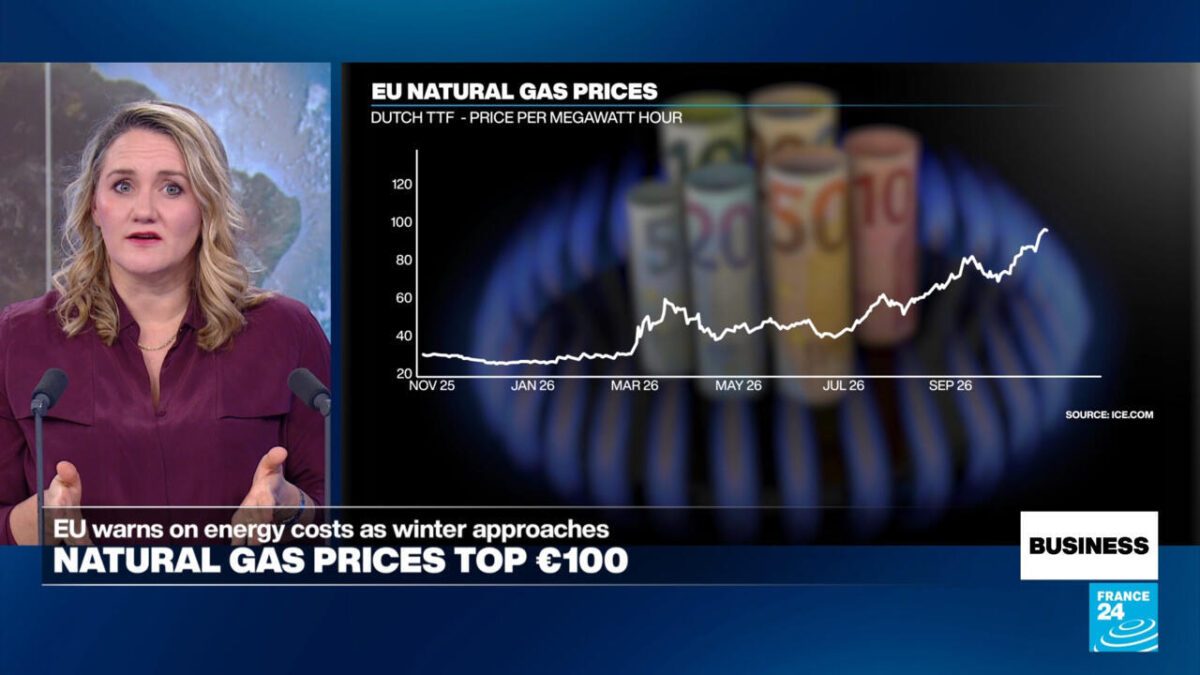
Europe’s energy markets are about to feel the chill of winter in a way they haven’t since 2022, and the first sign is stark: natural‑gas prices have surged past €100 per megawatt hour. The headline number alone sounds like a warning bell, but the real alarm is how quickly the market has sprinted back to pre‑pandemic volatility.
According to France 24, the price spike was recorded on Wednesday as the continent’s gas contracts hit the €100 mark for the first time in four years. The EU’s own data shows storage facilities are only 72 % full, a figure that sits uncomfortably close to the threshold that regulators consider “critical”.

Europe’s Energy Tightrope: Why the Gas Spike Matters
The timing could not be worse. As households brace for colder days, the EU Commission has publicly reassured citizens that supplies remain “secure”, yet the same statement is paired with a stark caution that the upcoming season will be “difficult”. The gap between official confidence and the raw numbers tells a story of political balancing.
In recent months, Europe has been wrestling with a cascade of supply‑side shocks: reduced Russian pipeline flows, lingering effects of the Nord Stream outages, and a global surge in demand as economies rebound from pandemic restrictions. Add to that the lingering after‑effects of the 2024 summer heatwave, which forced utilities to burn more gas to meet unexpected cooling loads. All these factors converge to push Europe’s gas market into a tight‑rope walk where any misstep could reverberate across the continent.

Moreover, the storage level of 72 % is not just a statistic; it reflects a strategic choice made by European governments to keep more gas on the market rather than lock it away. That approach was praised in 2022 when prices were low, but now it leaves the region exposed to price spikes just as winter demand ramps up. In fact, the EU’s own energy security doctrine warns that storage below 75 % should trigger contingency plans, a threshold Europe is now flirting with.
The Hot Take: Who Gains and Who Loses in This Gas Surge
First, the obvious losers are European households. With gas‑linked heating bills already under pressure from inflation, a jump to €100 per megawatt hour translates into higher monthly costs for millions. The EU’s consumer protection agencies have warned that vulnerable families could see energy poverty rates rise sharply, a development that will likely fuel political unrest in the run‑up to next year’s elections.

On the other side of the ledger, gas producers and traders stand to profit. Companies with long‑term contracts at lower prices can now sell spot gas at a premium, boosting their margins. This dynamic also revives the relevance of European gas fields that were slated for de‑commissioning, as governments scramble to keep domestic output alive to buffer the market.
But the real intrigue lies in the diplomatic arena. Europe’s reliance on external gas—whether from Norway, Algeria, or the increasingly strained Russian pipelines—has always been a lever of foreign policy. A sustained high‑price environment gives the EU more bargaining power to demand stricter contractual terms, yet it also risks alienating suppliers who may see Europe as a volatile customer. The paradox is that Europe could end up tightening its diplomatic grip while simultaneously weakening its energy leverage.
Meanwhile, the UK’s attempt to cushion its own households by capping energy bills showcases a divergent policy path that could set a precedent for Europe. If Britain’s measures prove effective, they may pressure EU ministers to adopt similar subsidies, a move that would strain already tight public finances. Critics argue that such interventions merely postpone an inevitable market correction, while supporters claim they are essential to prevent a social crisis.
A counter‑argument worth noting is that the EU’s diversified energy mix—renewables now accounting for over 40 % of electricity generation—might absorb part of the shock. In fact, recent wind and solar expansions have reduced overall gas demand, which could temper the worst of the price surge. Still, heating remains heavily gas‑dependent, and the seasonal swing will likely outpace the offset provided by renewables.
The stakes are also security‑related. A prolonged period of high gas prices could incentivise rogue actors to target Europe’s energy infrastructure, knowing that any disruption would amplify the economic pain. Cyber‑attacks on pipeline control systems or sabotage of storage facilities could become more attractive to hostile states seeking to exploit Europe’s vulnerability. Therefore, the gas price surge is not merely an economic footnote; it is a flashpoint for broader security concerns.
In this climate, the EU’s diplomatic corps must walk a tightrope: pressuring suppliers for better terms, coordinating with NATO allies on energy security, and managing domestic political fallout. The calculus is complex, and the margin for error is razor‑thin.
The winter ahead will test Europe’s resilience in ways that go beyond the thermostat. If the EU can keep the lights on without plunging households into debt, it will prove that a continent once dependent on external gas can adapt under pressure. If not, the season could become a catalyst for a deeper political reckoning about energy independence and the true cost of reliance on volatile markets.
Only time will tell whether Europe’s energy gamble pays off, or whether the continent will be forced to rewrite its security playbook in the cold.
Source: France 24