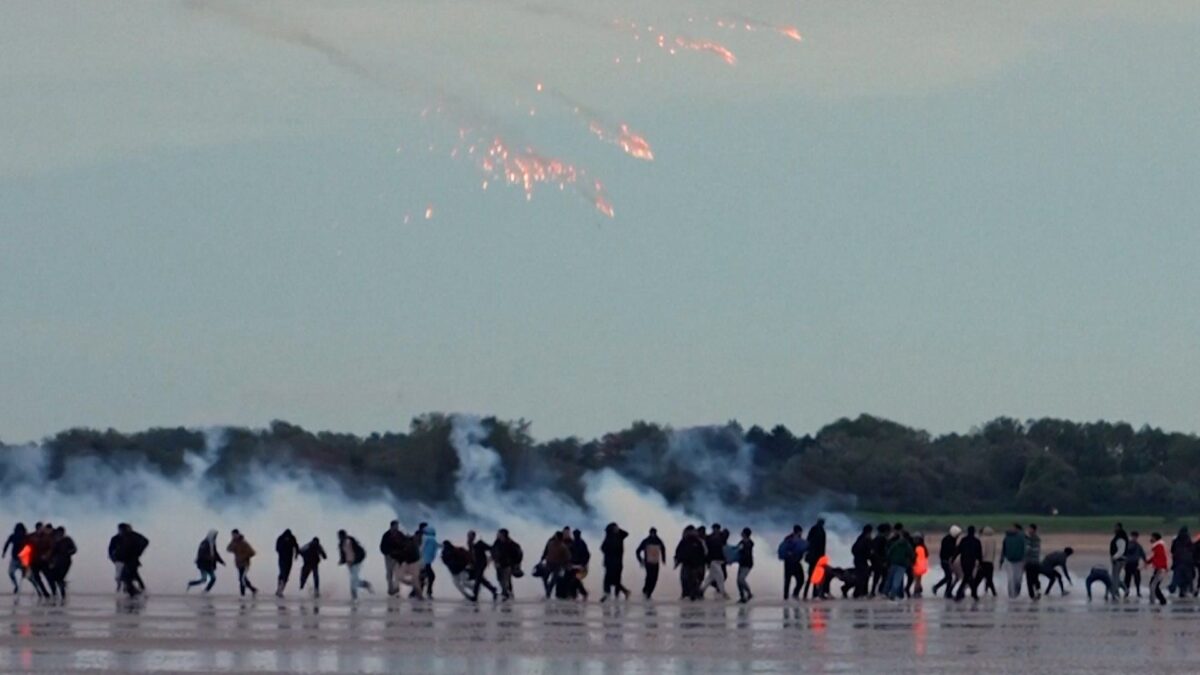
The **French** decision to unleash tear‑gas on a crowd of desperate migrants on a Normandy beach has forced the UK to stare at its own border policy in the harsh light of a neighbour’s desperation. It’s a stark reminder that the “European solution” to illegal crossings is as fragile as a sandcastle at high tide, and that the fallout will be felt far beyond the Channel’s choppy waters.
According to Al Jazeera, French police opened fire on a group of migrants gathered on a beach near Calais, using tear‑gas canisters to disperse them as they prepared to board makeshift boats bound for Britain. The operation took place on Monday afternoon and left several people coughing and fleeing inland, while authorities claimed the action was necessary to prevent a “dangerous” illegal crossing.
French police tactics and the Channel crisis
The use of crowd‑control weapons on a vulnerable population is not new for France, but the timing could not be more provocative. In recent months, the French government has tightened its coastal patrols after a surge in attempts to cross the Channel, a route that has become a grim shortcut for people fleeing war, poverty, and persecution. Meanwhile, the United Kingdom has been wrestling with its own political turbulence: a fragile coalition, looming elections, and a public weary of endless immigration debates.
The French move underscores a deeper strategic shift. By opting for a hard‑line response, Paris signals to Brussels and London that it will no longer tolerate what it calls “lawless” attempts to breach its borders. This stance follows a series of high‑profile incidents, including the tragic capsizing of a migrant boat off the coast of Brittany last spring, which claimed dozens of lives and sparked a wave of criticism aimed at European inaction.
Critics argue that the tear‑gas episode merely pushes the problem inland, forcing migrants to seek shelter in overcrowded camps or to attempt even more perilous routes. Human‑rights groups have condemned the French authorities for using force that could violate international protection standards, while some French politicians defend the tactic as a necessary deterrent. In fact, the French interior minister has warned that “any attempt to use the Channel as a free‑way to the UK will be met with decisive action,” a statement that reads like a thinly veiled warning to both would‑be migrants and the British government.
The broader context is equally important. The French approach arrives at a moment when the European Union is trying to present a united front on migration, yet member states remain divided over burden‑sharing and border control. France’s aggressive posture could embolden other nations to adopt similar measures, potentially igniting a cascade of confrontations along Europe’s coastlines. Moreover, the incident risks inflaming tensions between France and the United Kingdom, especially as London continues to grapple with its own political calculus over immigration and asylum policy.
What this means for UK politics
For UK politicians, the French incident is a lightning rod that will inevitably be seized upon by both the opposition and the governing coalition. The Home Office, already under pressure to tighten entry rules after a spate of illegal arrivals, now faces a foreign‑policy dilemma: should it applaud France’s hard stance, or risk appearing complicit in a humanitarian breach? As Prime Minister’s press secretary put it, “the safety of our borders remains paramount,” a line that can be interpreted as tacit approval of any measures that keep migrants off British soil.
Opposition leaders, meanwhile, are likely to weaponise the story to expose what they see as the government’s failure to negotiate a coherent EU‑UK migration framework. In parliamentary debates, they may argue that the French use of tear‑gas highlights the absurdity of a fragmented approach, where one nation’s crackdown merely shifts the pressure onto another. The narrative could be spun to suggest that without a joint European strategy, Britain will continue to be the “final destination” for desperate people, forcing the UK to shoulder the humanitarian burden alone.
On the other hand, the governing parties may seize the moment to push forward stricter legislation, citing the French example as proof that deterrence works. Proposals could include expanding offshore processing facilities, tightening visa requirements, or even collaborating on joint patrols with French authorities. If passed, such measures would reshape the UK’s immigration landscape and likely provoke legal challenges from civil‑rights groups.
The episode also has a subtle but potent impact on public opinion. Recent polls show a slight uptick in voter anxiety over uncontrolled migration, and the visual of tear‑gas clouds over a beach is a powerful image that can sway undecided constituents. As the weekend’s events filter into Monday’s headlines, the British media will likely replay the footage repeatedly, feeding a narrative that frames the Channel as a “battlefront” rather than a humanitarian corridor.
Nevertheless, it would be naive to assume that the French action solves any problem. It merely relocates it, and the underlying drivers—conflict in the Middle East, climate‑induced displacement, and economic desperation—remain unaddressed. As long as people risk everything to reach the UK, any hard‑line policy will be a temporary bandage on a chronic wound. The French episode forces the United Kingdom to confront a stark choice: double down on deterrence and risk international censure, or lead a more compassionate, coordinated approach that acknowledges the shared responsibility of Europe.
The tear‑gas clouds that rose over that Normandy shore are a harbinger of what could become a new normal in European border politics. Whether Britain embraces the French playbook or seeks a different path will shape the next chapter of UK politics, and perhaps, the very identity of the island nation as a refuge or a fortress. The question now is not just how many more migrants will be stopped, but whether the UK is prepared to shoulder the moral and political cost of a strategy built on fear.
Source: Al Jazeera