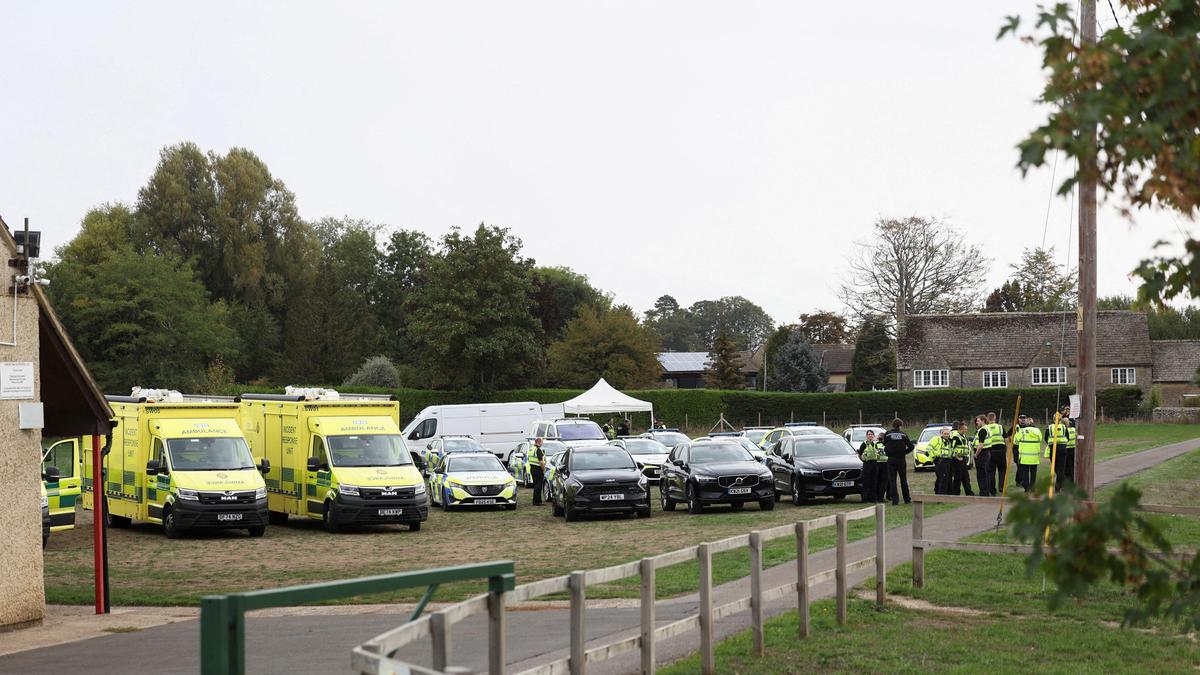
Police officers swarmed the countryside around RAF Fairford on a chilly September evening, evicting families from their homes and hauling two men away on suspicion of handling explosives. The dramatic scene, captured by local residents, underscores how quickly a remote air base can become a flashpoint when geopolitics collides with domestic security.
According to The Hindu, the British government authorised the United States to use the Fairford facility for strikes against Iranian missile sites that have been targeting commercial vessels in the Strait of Hormuz. The police operation, described by officials as a “preventive safety measure,” followed a credible threat that a bomb may have been planted on the base’s perimeter.
Police action at RAF Fairford raises security alarm
The evacuation of civilians from nearby villages was not a routine drill. Police cordoned off a three‑kilometre radius, set up mobile command posts, and conducted a rapid search of the airfield’s perimeter. While the two detainees remain unnamed, authorities claim they were found in possession of materials that could be used to assemble an improvised explosive device. The police presence, however, sparked a wave of anxiety among locals who fear that their quiet hamlets could be drawn into a wider conflict.
The decision to involve police rather than military security forces reflects a legal nuance: the United Kingdom’s domestic law places the policing of potential terrorist threats squarely under civilian jurisdiction, even when the target is a strategic military installation. In practice, this means police officers, trained for urban counter‑terrorism, are now patrolling the grasslands surrounding one of America’s most important forward operating bases in Europe. The move also signals to the public that the threat is being treated as a criminal act, not merely a wartime contingency.
Strategic fallout of U.S. strike authorisation
The authorisation granted by London to Washington comes at a volatile moment in Middle‑East politics. Iran’s recent missile launches into the Persian Gulf have disrupted global oil flows, prompting the United States to seek a foothold for precision strikes. RAF Fairford, with its long runway and proximity to the Atlantic, offers a rare European launchpad capable of housing heavy bombers without the diplomatic baggage of a Middle‑East base.
For the United Kingdom, the gamble is twofold. On the one hand, it reaffirms the “special relationship” with the United States, potentially securing defence contracts and intelligence sharing that could bolster Britain’s own security posture. On the other hand, it drags the UK into a conflict that could provoke retaliatory attacks on British assets abroad, or even domestic targets, as Iranian proxies seek to demonstrate their reach. The police operation at Fairford may therefore be seen as a pre‑emptive attempt to neutralise any home‑grown sabotage that could embarrass the government and give Tehran a propaganda victory.
Meanwhile, the incident has already rattled markets. Energy futures spiked as traders priced in the risk of further disruptions to shipping lanes, while defence stocks experienced a modest uptick on speculation that the United Kingdom might be called upon to supply additional support. Analysts note that the “fairly limited” scale of the police response suggests authorities are confident the threat is contained, yet the very fact that explosives were allegedly found on a U.S.‑used base could erode investor confidence in the stability of the trans‑Atlantic security arrangement.
Critics argue that the United Kingdom is selling out its sovereignty for a handful of American bombers. They point out that the British public was never consulted about the decision to host strikes that could make the nation a target for Iranian retaliation. In response, officials stress that the operation complies with existing parliamentary authorisations for joint defence initiatives, and that the police presence demonstrates a commitment to rule of law rather than military overreach.
Nevertheless, the episode highlights a broader tension: the blurring line between external war‑fighting and internal policing. When police are tasked with securing a foreign‑military mission on home soil, the civil‑military divide erodes, and the public’s perception of safety can shift dramatically. If a bomb had indeed been planted, the police acted swiftly; if the threat was exaggerated, the evacuation may have sown unnecessary fear and mistrust.
The episode also raises questions about intelligence sharing between Washington and London. How much did U.S. agencies know about the alleged bomb, and why was the information relayed to British police rather than the base’s own security personnel? The answer could illuminate whether the joint operation is a model of cooperation or a patchwork of bureaucratic hand‑offs that leave gaps exploitable by hostile actors.
In the weeks ahead, the British government will need to navigate a delicate balancing act. It must reassure the public that police are capable of protecting critical infrastructure, while also convincing allies that the United Kingdom remains a reliable partner for high‑risk operations. The handling of the Fairford incident will likely be a litmus test for future joint missions, especially as the United States contemplates deeper involvement in the Gulf’s escalating missile standoff.
As the sun set over the Cotswolds, the empty houses and silent streets stood as a stark reminder that global power plays can intrude on the most pastoral corners of Britain. Whether the police operation will be remembered as a successful interdiction or a cautionary tale of over‑reach remains to be seen, but one thing is clear: the line between war and home security is thinner than ever, and the next Monday’s political headlines will be shaped by today’s decisive, and controversial, police move.
Source: The Hindu