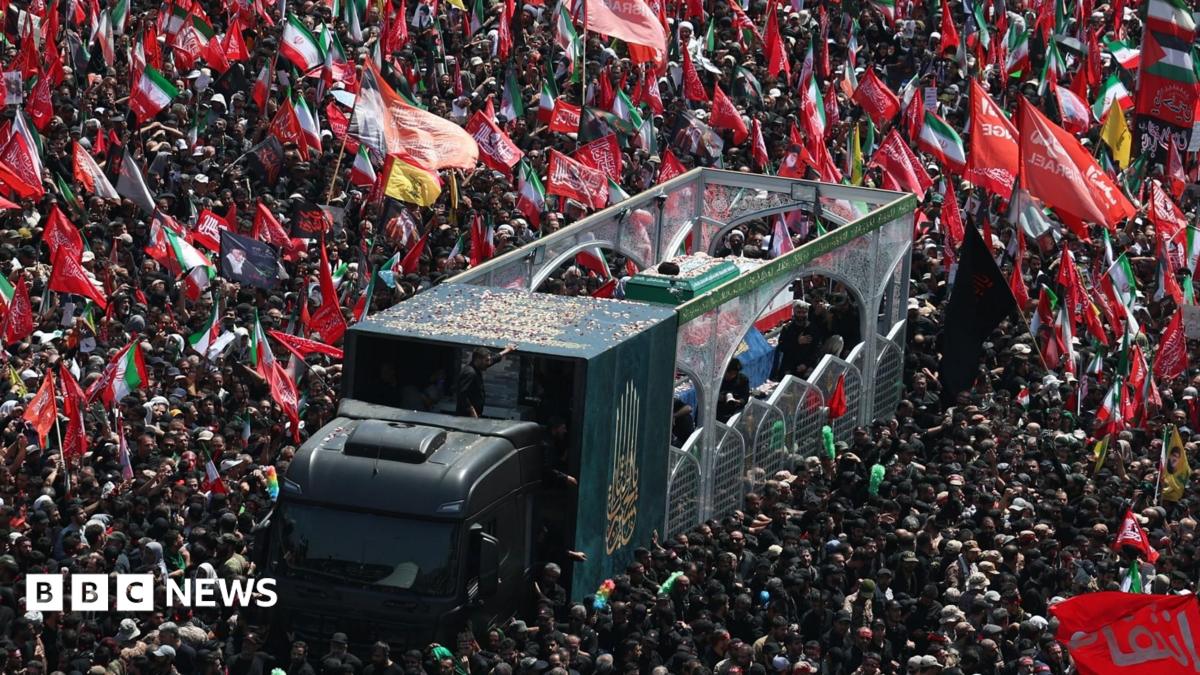
The sight of **huge** crowds filling Tehran’s streets for the supreme leader’s funeral procession is meant to send a message. But what message, exactly, are we supposed to receive? Is it genuine popular mourning, or a meticulously choreographed display of state power, designed for maximum internal and external impact? This isn’t just a farewell; it’s a declaration.
According to BBC Middle East, vast numbers of people gathered in the Iranian capital, Tehran, for the funeral procession of the former supreme leader. Many among the mourners were observed waving Iranian national flags and red banners, which reportedly symbolised vengeance for the leader’s war death.
This isn’t merely a funeral; it’s a political performance on an immense scale, carefully staged to project an image of national unity and unwavering loyalty to the regime. The timing, the symbolism, the sheer scale of the turnout — all of it speaks volumes about the Islamic Republic’s enduring grip on power, despite persistent internal dissent and international isolation. The former supreme leader, a figure of immense spiritual and political authority, represented the very bedrock of the clerical establishment. His passing, therefore, is a moment of profound transition, but also an opportunity for the state to reaffirm its foundational principles and consolidate its narrative.
The waving of Iranian flags is standard, but those red banners, explicitly symbolising “vengeance,” are a stark reminder of the regime’s confrontational stance, both regionally and globally. This isn’t just grief; it’s a militant declaration. It underscores the deep-seated ideological commitments that continue to shape Iran’s foreign policy and its internal security apparatus. For a state that frequently frames its existence in terms of resistance and struggle against external enemies, such a display at a leader’s funeral is not just symbolic; it’s a foundational act of political theatre. It reinforces the idea that the revolution’s spirit, even in mourning, is one of defiance.
Let’s be clear: a **huge** crowd in an authoritarian state is rarely a purely spontaneous outpouring of emotion. While genuine grief for a national figure no doubt exists among some, the scale and uniformity of such demonstrations often suggest a well-oiled state machinery at work. People are incentivised, pressured, or even outright compelled to attend. Public sector workers, students, and members of various state-affiliated organisations are frequently mobilised for such events, understanding the subtle — or not-so-subtle — implications of their absence. This makes discerning the true depth of popular support a complex, often impossible, task for outside observers.
The regime, however, doesn’t care about our ability to discern. It cares about the optics. It wants to show the world, and more importantly, its own populace, that it commands overwhelming support. This display serves as a powerful deterrent to internal opposition and a message of strength to external adversaries. When the streets are choked with such numbers, waving banners of vengeance, it sends a chilling message to anyone contemplating dissent: the state is strong, unified, and unyielding. The narrative of a powerful, resilient Islamic Republic is meticulously crafted through such spectacles, aiming to silence critics and rally the faithful.
Moreover, the emphasis on “vengeance for the former supreme leader’s war death” is a potent, if dangerous, rallying cry. It binds the nation to a perceived historical grievance, justifying continued military readiness and an uncompromising foreign policy. It frames any future action, particularly against perceived enemies, as a sacred duty, a continuation of a struggle for justice. This is not just about mourning a leader; it’s about solidifying an entire ideological framework that relies on a constant state of perceived threat and the need for collective retribution. It ensures that the legacy of a hardline stance persists beyond the individual.
However, it is crucial not to dismiss the genuine emotions of a segment of the population. For many devout Iranians, the supreme leader is a revered spiritual guide. Their grief is authentic, and their presence is a reflection of deep-seated religious conviction. The challenge for any observer is separating this genuine piety from the state’s strategic manipulation of public sentiment. The regime masterfully blends religious devotion with political loyalty, making it difficult to critique the latter without appearing to attack the former. This is the sophisticated, often insidious, nature of ideological control in a society where faith and governance are intrinsically linked. It’s a tapestry of genuine belief interwoven with state-orchestrated performance, making any simple interpretation a shallow one. The **huge** turnout is thus a testament to both.
This funeral, therefore, is more than a final farewell. It’s a strategic assertion of enduring power, a cultural performance designed to project unity and strength. It’s a message to the world that Iran stands firm, and to its people, that the authority of the state remains absolute. The real question is whether this elaborate theatre can truly mask the underlying tensions and discontents that simmer beneath the surface of such an imposing, monolithic display.
So, as the global media focuses on the sheer scale of the crowds, we must ask ourselves: what price is paid for such a grand spectacle, and what hidden truths does it conceal about the future of Iran?
Commentary · Current Affairs desk · Facts attributed to sources · Editorial policy · Corrections
Source: Source