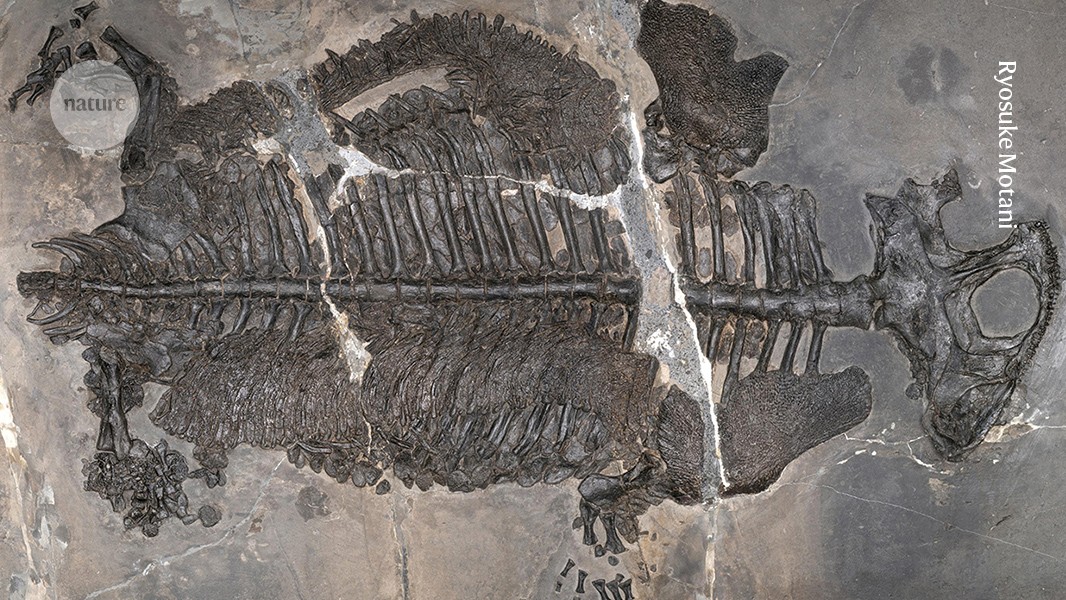
The word *Evolutionary* gets tossed around like a buzzword, but this new discovery forces us to ask whether we’ve been underestimating the ingenuity of ancient life. An armored amphibian, bizarre enough to look like a sci‑fi tank, swam the salty seas of the Late Triassic, proving that nature’s toolbox was far more experimental than most textbooks suggest.
According to a Nature News report published on 26 October 2026, paleontologists have identified a previously unknown tetrapod whose heavy dermal plates likely allowed it to thrive in brackish waters where few vertebrates could survive. The fossil, recovered from sedimentary layers in what is now northern Italy, shows a mosaic of bone and keratin that formed a rigid exoskeleton, a feature more typical of early fish than amphibians.

Evolutionary implications for Late Triassic ecosystems
The presence of such an armored amphibian reshapes our picture of the Late Triassic marine landscape. Until now, scientists assumed that the seas of that era were dominated by early reptiles, fish, and a handful of primitive amphibians that avoided high salinity. This find suggests that evolutionary pressures—namely, the need to exploit new niches—produced far more radical body plans than previously thought. In fact, the armor may have served a dual purpose: protecting the animal from predators and acting as a semi‑permeable barrier against the osmotic stress of salty water. If so, it represents an early example of convergent evolution, echoing the protective shells of modern turtles and the scutes of crocodilians, yet arising in a lineage that would later abandon such heavy armor altogether.
The discovery also dovetails with recent advances in AI‑driven fossil reconstruction. Researchers used a deep‑learning model trained on millions of vertebrate scans to predict the soft‑tissue layout hidden beneath the fossil’s stone casing. This technological leap allowed them to infer muscle attachment sites and even hypothesize about the creature’s locomotion—something that would have taken years of manual comparative anatomy. In other words, AI didn’t just speed up the process; it opened a window onto evolutionary experiments that left no living descendants.

Hot take: AI, tech, and the future of paleontology
What does this mean for the broader scientific community? First, it signals that the “evolutionary narrative” we teach in classrooms is still incomplete, and that we should expect more outlandish forms to emerge as AI uncovers hidden patterns in the rock record. Second, it underscores a growing tension: while AI can generate astonishing reconstructions, it also risks amplifying existing biases in data sets. If the training libraries over‑represent certain clades, the algorithms may overlook or misinterpret truly anomalous specimens like this armored amphibian. Consequently, the hype surrounding AI must be tempered with rigorous peer review and cross‑disciplinary scrutiny.
The winners in this scenario are the institutions that invest in high‑resolution imaging and open‑source AI tools. Museums that digitize their collections and share raw scan data will become the primary sources for future breakthroughs, effectively monopolizing the next wave of “evolutionary” insights. Meanwhile, traditional field paleontologists who cling to hand‑drawn sketches risk being sidelined, unless they adapt to the new computational workflow. On the other hand, the public may become desensitized to spectacular finds if every new fossil is instantly rendered in photorealistic 3D, turning awe into background noise.

Critics argue that relying on algorithms could erode the craft of paleontology, turning it into a data‑processing exercise. Yet the evidence suggests that technology is not a replacement but an amplification of human curiosity. The armored amphibian would have remained a footnote if not for the synergy between meticulous field work and sophisticated AI analysis. Ignoring this partnership would be a mistake, especially as the planet’s remaining fossil sites face increasing threats from climate change and development.
In the end, the story of this weird, armored amphibian is a reminder that evolution is not a tidy ladder but a tangled bush of experiments—some successful, many dead‑ended, and a few spectacularly odd. As AI continues to peel back the layers of deep time, we should brace ourselves for more “evolutionary” curveballs that challenge our assumptions about who got to survive and why. The question now isn’t whether more bizarre creatures will surface, but whether we’ll have the tools—and the humility—to understand them.
Source: Nature News