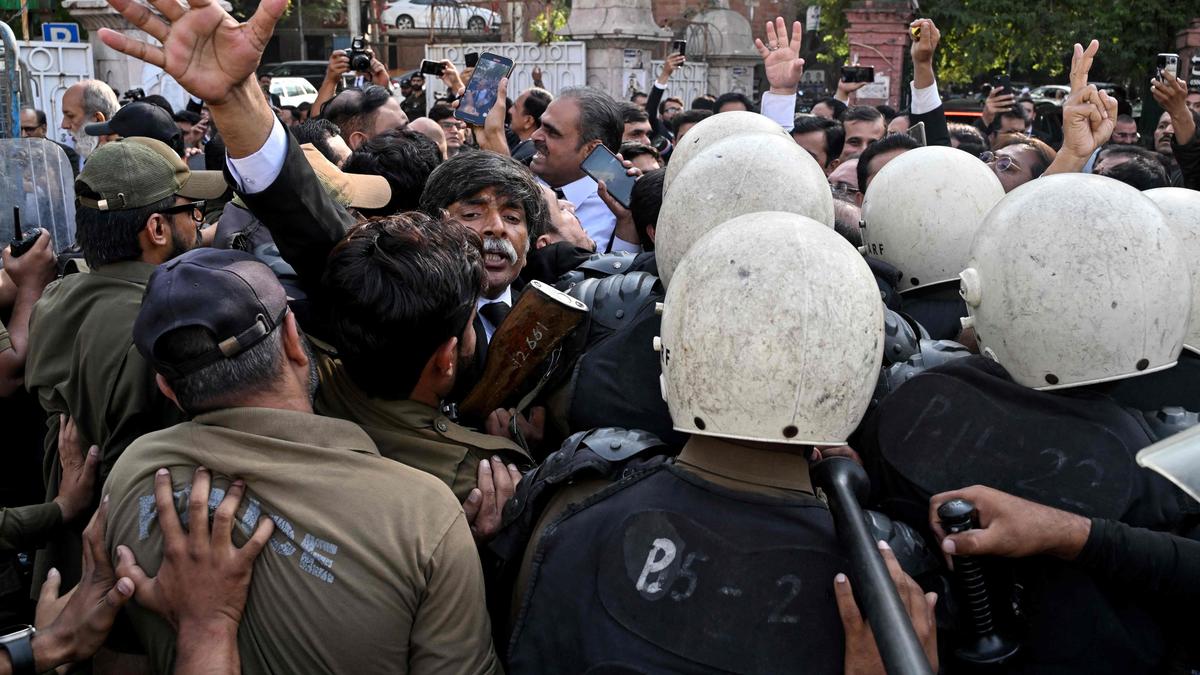
Why Pakistan decided to suspend democracy in a province it once praised for progressive reforms is a question that should keep every analyst up at night. The phrase “Why Pakistan” now echoes through corridors of power, media studios, and street‑level cafés across South Asia, demanding an answer that goes beyond the official press release.
According to The Hindu, the military‑backed federal government declared emergency rule in Khyber‑Pakhtunkhwa on Tuesday, invoking a surge in terrorist attacks as justification. The move follows a months‑long standoff with the Pakistan Tehreek‑e‑Insaf (PTI)‑led provincial administration and the recent incarceration of former Prime Minister Imran Khan.
Why Pakistan imposed emergency rule in Khyber‑Pakhtunkhwa
The decision did not emerge in a vacuum. Since the 2022 general election, PTI has ruled Khyber‑Pakhtunkhwa, positioning itself as a reformist force in a region plagued by militancy. However, the party’s confrontational stance toward the military establishment—particularly after Khan’s arrest on corruption charges—has turned the province into a political flashpoint. In fact, intelligence reports cited by the government claim a 40 percent increase in bombings and armed assaults over the past three months, a statistic that the military has leveraged to legitimize its intervention.
Meanwhile, the broader security environment has deteriorated. The Afghan border remains porous, allowing insurgent groups to regroup and launch cross‑border raids. Simultaneously, internal factions within the Pakistani armed forces have reportedly debated whether to adopt a hard‑line approach or seek a negotiated settlement with PTI. The emergency decree, therefore, serves a dual purpose: it grants the federal government sweeping powers to detain suspects without trial, and it signals to the military hierarchy that the civilian leadership is finally yielding to strategic imperatives.
The timing also aligns with a series of high‑profile attacks on schools and markets in Peshawar, which have inflamed public opinion. By invoking “national security,” the federal authorities aim to rally popular support, even as opposition leaders accuse them of weaponizing fear to crush dissent. The emergency rule grants the government authority to suspend the provincial assembly, impose curfews, and control the media—all tools that have historically been used to silence political rivals in Pakistan’s tumultuous past.
The political fallout and security gamble
From a strategic standpoint, the emergency could be a short‑term win for the establishment but a long‑term liability for Pakistan’s democratic credibility. The immediate beneficiaries are the military’s intelligence apparatus and the ruling coalition, which now enjoys unfettered access to the province’s administrative machinery. On the other hand, PTI’s grassroots network—still energized by Khan’s charisma—faces a crackdown that could either erode its base or turn it into a martyr‑like movement, depending on how the repression unfolds.
Critics argue that the security rationale is a thin veneer for a power grab. They point out that similar emergency measures in the 1990s and early 2000s failed to curb insurgency and instead deepened public mistrust. Moreover, the suspension of judicial oversight raises concerns about human‑rights violations, a point highlighted by local NGOs who fear that thousands could be detained without due process. The government, for its part, maintains that the extraordinary circumstances demand extraordinary measures, and it cites the recent killing of a senior army officer as proof that the threat is real and immediate.
International observers are watching closely. The United States and the United Kingdom have both issued statements urging restraint and respect for democratic norms, while China, Pakistan’s key economic partner, has offered tacit support, emphasizing stability over political pluralism. This diplomatic balancing act underscores a broader dilemma: can Pakistan secure its borders and curb militancy without sacrificing the very democratic institutions that legitimize its statecraft? The answer may hinge on whether the emergency will be lifted once the security metrics improve, or whether it will become a permanent fixture that reshapes the power dynamics between civilian politicians and the military elite.
In reality, the emergency rule also opens a technological front. Surveillance drones, AI‑driven facial‑recognition software, and data‑mining tools are being deployed to map protest movements and track suspected militants. While the government touts these tools as essential for “precision policing,” civil‑society groups warn that the same algorithms could be repurposed to silence dissent, creating a digital panopticon that outlasts any temporary security threat.
Nevertheless, the opposition is not entirely powerless. PTI’s legal team is already filing petitions in the Supreme Court, arguing that the emergency violates the Constitution’s basic structure. If the judiciary asserts its independence, it could force a rollback of the most draconian provisions, offering a glimmer of hope for a democratic reset. Conversely, a weak judicial response would embolden the establishment to extend emergency powers nationwide, a scenario that could trigger a constitutional crisis.
The stakes are clear: a mismanaged security campaign could plunge Khyber‑Pakhtunkhwa into a deeper cycle of violence, while an overreaching political crackdown could ignite nationwide protests, further destabilizing a country already grappling with economic turbulence and energy shortages. In this precarious balance, every decision reverberates far beyond the mountainous borders of the province.
Why Pakistan chose to trade constitutional guarantees for an emergency decree may be answered by the calculus of survival—both for the state and for the military’s grip on power. Yet the price of that calculation could be a loss of public trust that is far harder to rebuild than any militant network.
If the emergency is lifted in a year and the province returns to civilian rule, the episode will likely be framed as a necessary sacrifice. If, however, the emergency becomes a permanent feature, it will be remembered as the moment Pakistan turned its back on the democratic promise it once championed. The world will be watching, and the question remains: can the country reconcile security with liberty, or will “Why Pakistan” become a lament whispered by future generations?
Source: The Hindu